My log of the exoitc and invasive species in Orlando Florida. Native = Evolved here, Exotic = Evolved someplace else, Invasive = A danger to natives
Monday, November 22, 2010
11/21/10 Blanchard Park
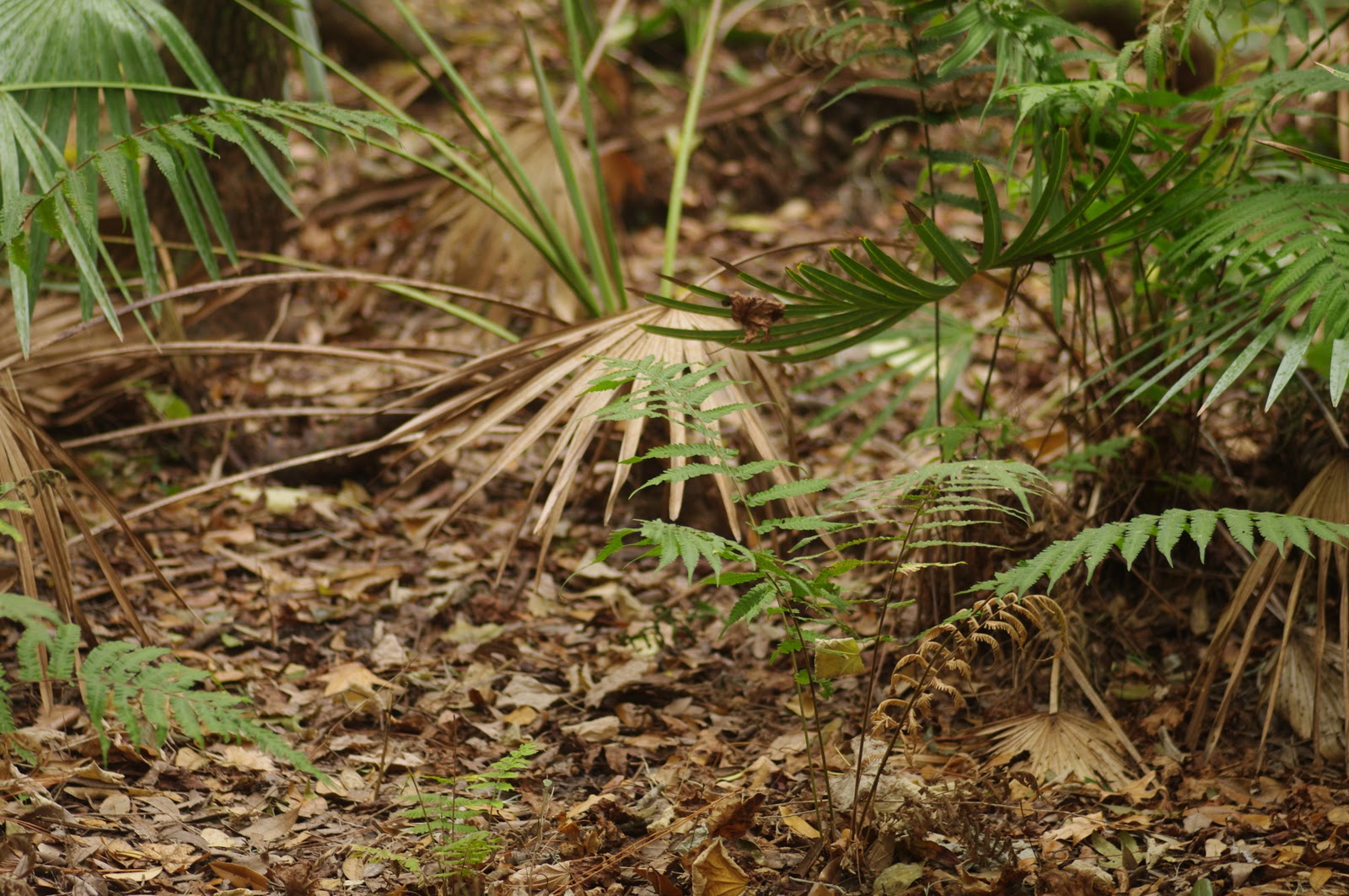
Blanchard Park is a big big project. I've been working the exotic plants here for many months. Mainly Cesar Weeds which dominated the landscape every where. In the before and after pictures above you see an area infested with Cesar Weed and in the next picture returned to it's native state.
Today I ended up collecting a lot of litter along with plants. For Cesar Weed I took out 313 plants. I also took out 7 Chinese Tallow Trees. I also collected 2 Water Hyacinth and 2 Water Lettuce plants to show to a class at my university.
11/18/10 The Big Econlockhatchee River
Today I wanted to get some environmental good done, so I after work I made use of the few hours left of sunlight and walked out into the swamp I live on the edge of. Water levels are low and I was able to cross a fallen tree to the other side of the river. There I found several Spanish Moth "convict" Caterpillars (Xanthopastis regnatrix). I was able to identify them with the help of staff at the Lukas Nusary Butterfly Encounter in Orlando.
I was surprised to find two, four foot Chinese Tallow Trees there which I promptly ripped out of the ground. I'm really getting to the point I can spot those spade shaped leaves from quite a distance, even through thick brush. See the second picture.
To get used to looking for some specific thing is called "search image".
Saturday, November 20, 2010
11/20/10 A Herpetology Lesson About Water Snakes
These two pictures were taken my supervisor at work. The top picture is a young Florida Banded Water Snake and the lower picture is a Water Moccasin. The Banded Water Snake is non-poisonous and the Water Moccasin is poisonous.
Water Moccasins have an undeserved reputation for being mean. I have not found this to be true, on my two encounters with them. They do have an aura about them and for me anyway you can tell them apart from a long distance.
Many thousands of non-poisonous water snakes (Florida has Brown Water Snakes, Altlantic Water Snakes, Mangrove Water Snakes, Green Water Snakes and Banded Water Snakes) are killed because people think every snake they see in the water is a Water Moccasin. Personally I would never kill a Water Moccasin either.
11/19/10 A Return to Mead Gardens
The November days are cooler and Sagrei hunting is slow. So I turn my focus to exotic invasive plants. For this visit to the park I pulled out 100 Cesar Weeds, 13 Chinese Tallow Trees and two Ear Trees. The Cesar Weeds here are tall and past the flowering stage. Every time I pulled one I got covered with clinging seeds.
I met three people there who are doing a history of the park. They asked if I would also work on taking out Skunk Vine and Cat's Claw. I don't know these plants and will have to research them. I noticed many dieing Air Potato Vines and they told me the park was spraying to kill them. They warned me not to eat off the Beauty Berry Bushes also because of the spraying.
There is a wet land on one end of a park with a big sign saying something, "Wetlands Restoration, Exotic Vegetation Threatens the ecological longevity..." I have never seen anyone other than me taking out exotics. There are several full grown Chinese Tallow Trees in that wetland and I "girdled" two of them. See the 2nd picture. Girdling is the botany/forestry term for cutting a ring of bark off a tree to strangle it. Now that I think of it, girdling a large exotic invasive tree might do some double good. If the dead tree then provides homes for wildlife, then that is a double bonus.
The first time I learned what girdling was, it was a friend of mine who had tied a dog to a tree. The dog ran around the tree wearing the bark down with its chain. The tree later died.
If the city of Winter Park want to remove these trees it will cost many thousands of dollars. If I kill them and let the dead trees provide homes for wildlife, it will cost nothing.
Thursday, November 18, 2010
11/18/10 WebShots.com and Flicker.com
I post Florida wildlife pictures for free anywhere I can. I do this to provide pictures for anyone wanting to learn more about the wonderful environment we have here. My hope is that the more we learn about what is out there, the less likely we are to build our own nests on it. I post pictures on webshots.com and Flicker.com.
The top picture is of a baby Soft Shell Turtle. This is actually a digital picture of a 35mm picture I took several years ago. The lower picture is of three Sandhill Cranes, two parents and a baby. Notice the brand new high school in the background which ate up a big chunk of thier nesting grounds.
11/18/10 Why animals try to eat litter
The top picture is of an Anti-freeze plastic bottle, chewed open by a small mammal. The bottom picture is of a beer can bitten by a small Alligator. But why do animals want to eat things made of plastic or metal? The answer is what was in there before the bottle or can was illegally tossed into a waterway. Animals are tricked by the food like smell and try to eat or eat though things that could be dangerous to them.
A solution would be to recycle bottles and cans instead of throwing them into our water supply.
11/18/10 A Book about Invasive Species
I recently read the book Alien Invaders by Jane Drake and Ann Love. This book is for ages 9 -12 and is fine for adults too. It covers exotics from the microscopic size to giant European pigs. One thing I liked best about this book is it lists the domestic-feral cats as the destructive exotic they are. Many books shy away from calling cats an exotic as it is not politically correct. Animals raised and bread by humans are by law called “Domestic”. By law domestic animals must be under the control of a human at all times. Examples would be the Florida lease law for cat and dogs, or a fence restraining a herd of cows or horses. I’ve had cats as pets most of my life. I’m not anti cat by any means; I’m just anti “outdoor” cats decimating our native species.
It’s funny how exotics often make the best pets. This book did have a chapter on Cane Toads. I once took a trip to Homestead Florida to collect some exotic Can Toads (Bufo marinus) to keep as pets. I kept four of them for years and they got bigger and fatter each month on a diet of exotic Cuban Anoles (Anolis sagrei).
There was also a chapter on the Walking Cat Fish. I once saw a Walking Cat fish on the East side of Orlando. It was a rainy day and the cat fish was winding back and forth across a parking lot. If I had known that it was exotic at that time I would have fed it to my pet Snapping Turtle. But I didn’t know and we both went on about our day. Knowledge is power and lack of knowledge leads to trouble.
Alien Invaders also had a chapter on Kudzu vine. I haven’t seen Kudzu much here in Orlando. I hear it’s more a problem in North Florida and adjoining states. Here we fight Air Potato vines which often cover entire wooded areas. Once I identified Air Potato (Dioscorea bulbifera) as an exotic I set to ridding my 5 ½ acre property of it. I have rid my property of Air Potato and Cesar weed (Urena lobata) which took me a year. Now I’m working on getting the thousands and thousands of Cesar Weed plants out of Blanchard Park. I’ve removed and burned over six thousand Cesar Weed plants as of this writing.
Also on my hit list are Fire Ants (Solonopsis invitis), Cuban Tree Frogs (Osteopilus septentrionalis), Taro plants (Colocasia esculenta), Water Hayacinths (Eichhornia crassipes), Water Lettuce (Pistia stratiotes) and Chinese Tallow Trees (Sapium sebiferum).
Subscribe to:
Posts (Atom)